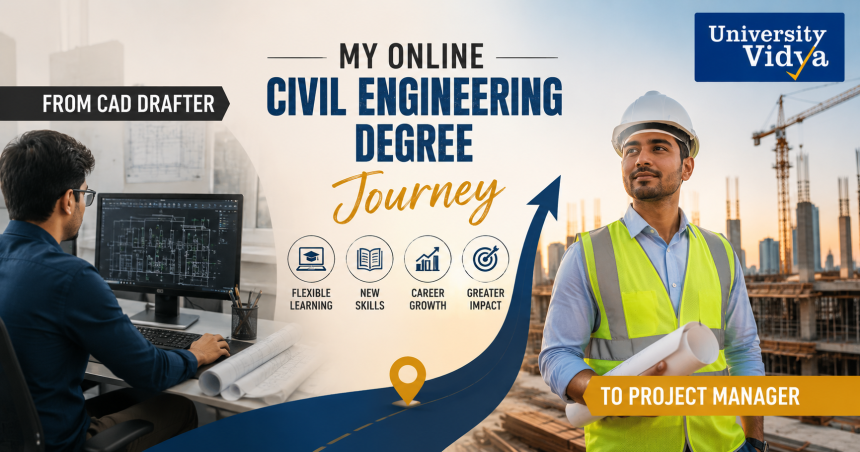

From CAD Drafter to Project Manager: My Online Civil Engineering Degree Journey
For five years, my professional world was confined to a glowing monitor, a high-precision mouse, and endless 2D AutoCAD lines. As a CAD drafter, I was incredibly fast at drawing structural blueprints, but I deeply lacked the theoretical knowledge to actually design them. I knew exactly how to draw a load-bearing beam, but I had absolutely no idea how to calculate the stress it could handle.
I hit a massive career ceiling, watching younger, degree-holding engineers get promoted to Project Manager (PM) while I stayed stuck at my drafting desk. I knew I needed a significant professional upgrade, so I decided to return to higher education and strengthen my technical qualifications.
If you are a working professional feeling stuck in a technical rut or a parent trying to guide your child toward a future-ready career path, this is my unfiltered story. I will share exactly where I struggled early on, the specific study tactics that helped me improve, and how pursuing a flexible engineering programme transformed my approach to learning and career development.
The Early Stumbles: Escaping the 2D Mindset
When I first started my remote degree, I was incredibly confident about my industry experience. I assumed that because I had drawn hundreds of commercial buildings, theoretical physics and advanced calculus would be easy. That assumption became my first major challenge as a returning student.
I tried to study structural mechanics the same way I had learned software shortcuts: by casually memorizing concepts on Sunday nights. My brain struggled with the complex mathematics, and I failed my very first structural analysis midterm. That failing grade was difficult to accept, but it forced me to realise that engineering requires a much higher level of analytical discipline and consistent study.
Looking back, that setback became an important turning point. It pushed me to develop a more structured approach to technical learning, practise mathematical concepts regularly, and connect theory with practical engineering applications. For working professionals who want to strengthen their qualifications while continuing their careers, an Online Civil Engineering Degree can offer a flexible pathway to deepen their technical knowledge and prepare for greater responsibilities in the construction and infrastructure sector.
I had to completely tear down my lazy study habits and rebuild a rigid, daily routine. To successfully transition from a drafter to an engineer, I implemented a few highly specific strategies:
- The 5:00 AM Shift: I stopped studying at night when I was exhausted and began waking up at 5:00 AM to tackle intense math while my mind was fresh.
- Applying Theory at Work: I started taking my textbook to the drafting office, matching the theoretical equations I was learning to the live blueprints I was drawing.
- Active Questioning: I forced myself to stop hiding behind my screen and began asking the senior engineers at my firm to explain their design choices.
Expanding My Blueprint: Cross-Disciplinary Lessons
Once I fixed my study routine, the academic fog finally lifted, and I discovered the hidden power of a digital campus. I initially feared that distance learning would mean studying in total isolation. Instead, I found myself collaborating with ambitious professionals from incredibly diverse industrial backgrounds.
During a virtual seminar on site management, I partnered with a site supervisor who was pursuing Online Mining Engineering. His practical insights into soil mechanics and deep-earth excavation completely changed how I viewed foundation design. We frequently exchanged ideas, blending his field grit with my drafting precision.
The cross-training did not stop there. I learned the complexities of powering large commercial sites by collaborating with a peer enrolled in Online Electrical Engineering. I even gained a deep understanding of concrete curing times and material corrosion by studying alongside a student taking an Online Chemical Engineering Course.
This exposure to different disciplines made me a highly adaptable problem solver. For parents researching education options for their kids, this is the true value of modern digital universities: they naturally foster a global, interdisciplinary mindset.
The Career Shift: Becoming a Project Manager
To help you visualize this massive career transformation, I often compare my old mindset to my new one. Earning this degree was not just about learning new math; it was about completely rewiring how I viewed the construction industry.
As a CAD drafter, the primary focus is often on creating accurate, clean, and detailed digital drawings, while a project manager must look beyond the drawing to ensure that the physical project is safe, efficient, and financially successful. The problem-solving approach also differs: a drafter may depend on engineers for technical solutions, whereas a project manager needs to analyse project data, evaluate challenges, and make informed decisions independently. Communication is another major distinction, with drafters often working within a technical environment, while project managers coordinate diverse teams of contractors, engineers, clients, suppliers, and other stakeholders to keep the project moving successfully.
By my final semester, my firm's leadership could not ignore my growth. When a complex commercial project started falling behind schedule, I stepped in and used a resource-allocation framework I had just learned in class. I reorganized the drafting team, communicated directly with the site engineers, and brought the project back on track.
That single initiative earned me a direct promotion to Junior Project Manager. I broke out of the drafting department because I proved I could handle high-level, strategic leadership.
Of course, finding the right educational foundation was the catalyst for all of this success. When I first started looking for a degree, the sheer volume of options was paralyzing. I eventually found my footing using University Vidya to seamlessly guide my university selection. Their platform helped me find a fully accredited, highly respected curriculum that perfectly accommodated my demanding full-time job.
Drafting Your Own Future
Looking back at my glowing CAD screen, leaving my professional comfort zone was the most terrifying, yet highly profitable, decision I have ever made. The digital classroom tested my resilience, shattered my bad habits, and transformed me from a passive drafter into an authoritative project leader.
You do not need to pause your life, quit your job, or sacrifice your current salary to build an elite engineering foundation. The tools and platforms exist to help you upskill on your own terms.
Take absolute control of your career trajectory today. Start mapping out your educational goals, embrace the struggle of learning new concepts, and start engineering the executive future you actually deserve.

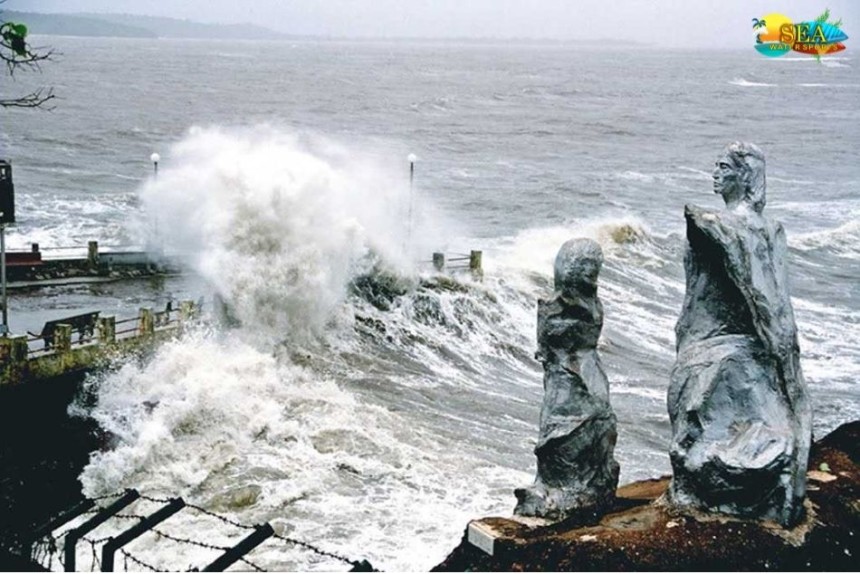
Tracing Goa's Historical Heritage: Tales of Romance, Grandeur, and For...



How To Choose The Right Acoustic Panels and Solutions for Your Space?